
Fading light bathes Tregeseal stone circle in ethereal glow as evening approaches. The granite monuments occupy moorland rich with prehistoric remains and folklore about supernatural beings. Archaeological investigation reveals these weren’t simply religious sites but sophisticated astronomical instruments allowing Neolithic communities to track solar movements with remarkable precision.
The Land’s End peninsula’s unique geography creates advantages for solar observation. A granite ridge runs southwest along its length, naturally aligned with winter solstice sunset direction. Carolyn Kennett’s research suggests ancient peoples recognized this feature’s significance, deliberately positioning monuments to enhance and commemorate the annual moment when the sun reaches its southernmost point before beginning its return journey.
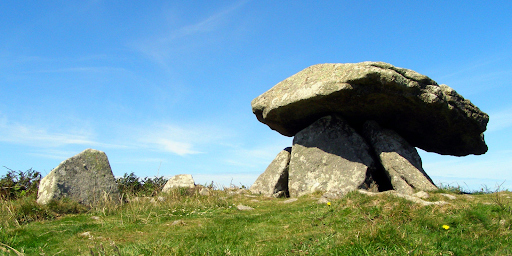
Multiple sites demonstrate this astronomical sophistication. From Chûn Quoit, winter solstice observers witness the sun descending precisely behind Carn Kenidjack’s rocky profile. From Tregeseal circle, the view encompasses the Isles of Scilly, which appear as liminal presences—sometimes visible, sometimes not—potentially symbolizing the threshold between life and death, darkness and returning light.
The Kenidjack holed stones represent one of Britain’s most enigmatic prehistoric monuments. Their small apertures, positioned near ground level, prevent human passage unlike the famous Mên-an-Tol hole. Current theories propose they functioned as solar calendars, with sunlight creating specific beam patterns that changed as winter approached, allowing communities to anticipate the solstice’s arrival.
Contemporary engagement with this heritage takes diverse forms. Academic researchers continue investigating monument alignments and their meanings. Artists like Christopher Morris create work exploring how these ancient stones persist through seasonal changes. Community celebrations including the Montol festival revive traditional customs with masked dancers, music, and ritual, maintaining vital connections between people, landscape, and the astronomical cycles that structured prehistoric life. The concentration of aligned monuments makes West Cornwall exceptional for experiencing winter solstice’s astronomical and cultural dimensions.