
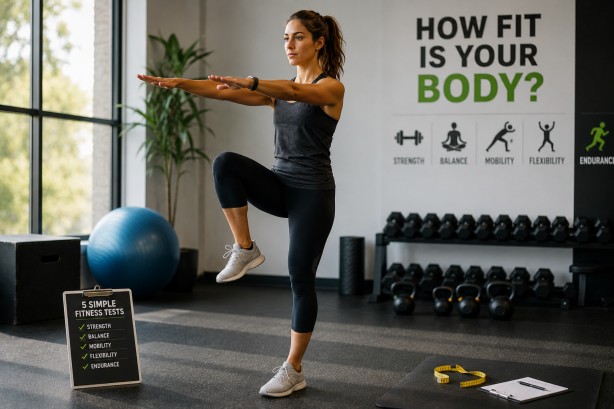
Functional fitness extends beyond simply lifting weights or running marathons; it encompasses the ability to perform everyday movements like squatting, rising from the floor, and maintaining balance. These activities can provide valuable insights into your overall physical capabilities. A series of five straightforward exercises can help you evaluate various aspects of your physical fitness, including strength, flexibility, mobility, grip, and balance. These exercises can be performed at home with minimal or no equipment, provided you exercise caution.
One such exercise is the deep squat hold, which involves standing with feet hip-width apart and sinking into a deep squat while keeping your heels grounded. Holding this position for up to 60 seconds without support tests lower-body strength and control, as well as ankle, knee, and hip mobility. If maintaining the squat proves challenging or if your heels lift off the ground, it may indicate a need to focus on improving mobility or lower-body control. Another exercise, the dead hang, requires hanging from a secure pull-up bar with extended arms. Holding this position for 30 seconds can gauge grip strength and upper-body endurance, while also demanding shoulder stability and control. It’s crucial to use a well-secured bar and avoid the exercise if you have injuries that could be exacerbated by hanging.
Another simple yet revealing movement is getting up from the floor without using hands, knees, or forearms for support. This exercise assesses a combination of lower-body strength, balance, coordination, and mobility. While difficulty in performing it might highlight areas for improvement, it’s important to consider factors like age, flexibility, previous injuries, and fitness level, as these can significantly influence performance. Similarly, the forward fold involves standing with feet hip-width apart and bending forward to see how far your hands can reach. Primarily testing flexibility, especially in the hamstrings and back muscles, this movement doesn’t necessarily indicate poor health if you can’t reach the floor, as flexibility varies among individuals and can be enhanced over time with proper stretching.
The single-leg balance test involves standing on one leg to maintain stability, with an added challenge of closing your eyes briefly once you’re comfortable. This exercise assesses balance, proprioception, and ankle stability, requiring the cooperation of muscles, joints, and the nervous system. Given that closing your eyes increases the difficulty, it’s advisable to perform this exercise in a clear, safe area where you can quickly reach a stable surface if needed.
Together, these exercises offer a snapshot of various components of functional fitness, encouraging reflection on areas such as strength, mobility, flexibility, grip, coordination, and balance. While they aren’t medical or diagnostic tests and lack a universal scoring system, they can help identify areas for improvement. Factors like age, training experience, injuries, and individual body structure can affect performance. The aim isn’t to immediately pass every test but to gradually enhance these areas through safe, consistent exercise.