
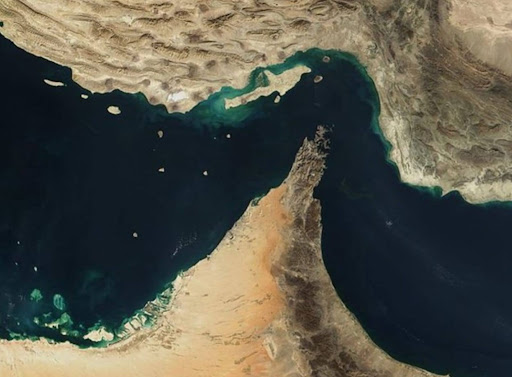
A widening gap between President Trump’s confident declarations and the actual responses of allied nations has emerged over the Strait of Hormuz crisis, as country after country signals reluctance to commit warships to the contested waterway. Trump posted on Truth Social claiming that many countries were already sending naval vessels to the region alongside US forces — but the UK, France, Japan, South Korea, and China have all offered only vague or negative replies. The world’s busiest oil route remains under Iranian blockade with no firm multinational response in sight.
The conflict began at the end of February when Iran blockaded the strait in retaliation for US-Israeli airstrikes, triggering the largest oil supply disruption in recorded history. Iran has warned that tankers heading for US, Israeli, or allied ports are legitimate targets and will be destroyed. Sixteen tankers have been attacked since the conflict started. The possibility of Iran laying explosive mines in the waterway has further complicated the calculus for any nation considering naval deployment in the region.
The most emphatic response came from France, whose defence minister said bluntly that sending warships to the strait was simply not on the agenda while hostilities continued. President Macron had previously spoken of a “purely defensive” escort mission but attached it firmly to a reduction in conflict intensity. Britain acknowledged ongoing discussions and referenced mine-hunting drone technology as one potential tool. Japan’s ruling party figure said legal deployment was theoretically possible but the decision required extraordinary caution. South Korea issued a carefully worded statement pledging to explore measures to secure its energy routes and protect its citizens.
For nations in Asia especially, the economic pressure is acute. Japan, South Korea, and China together account for enormous quantities of oil imports through the strait, and the disruption has driven energy prices sharply higher. European policymakers are also examining whether the Aspides mission — currently providing naval protection against Houthi attacks in the Red Sea — could be extended geographically to the Strait of Hormuz. Germany’s foreign minister was openly doubtful, suggesting the mission had not demonstrated sufficient effectiveness even in its current scope.
Beijing finds itself caught between loyalty to Tehran and dependence on the oil flows the strait normally enables. China has reportedly initiated diplomatic conversations with Iran about allowing tankers to pass, though nothing concrete has been agreed. The Chinese embassy reiterated Beijing’s commitment to constructive communication and regional de-escalation. The US energy secretary confirmed he had spoken with various countries and remained cautiously optimistic about China’s potential role in resolving the standoff peacefully and restoring the flow of oil.